
Clay County Projected Versus Actual Release
A projected date is a calculation based on the sentence, credit, and release rules known at that time. For a Tennessee state prisoner, the public FOIL record often uses the label Release Eligibility Date, or RED. That date marks when a sentence first becomes eligible for the applicable release mechanism. It does not promise parole, approval of a release plan, or physical departure on that day.
An actual release is an event that has occurred. For Clay County Jail, the permanent inmate register can show the date committed and date released. A release order states authority, while movement records can show that the person went to TDOC, another jail, federal custody, or ICE. A transfer ends Clay County physical custody but is not release to the community.
A pretrial detainee does not have a sentence-based release date. Bond, recognizance, dismissal, a detainer, or another court action may change custody. The Clay County court file and sheriff are the right sources, not a sentence calculator.
Find a Clay County Release Date
Start by asking which agency has the person. Clay County Jail, TDOC, BOP, and ICE maintain separate records. Similar terms can hide major differences, so use the following path and preserve the exact label returned by each source.
- Call the Clay County Sheriff's Office at (931) 243-3266 if the person was booked locally. Ask whether custody is current and whether any exit was release or transfer.
- For a local sentence, request the judgment and jail-credit order from the Clay County Circuit Court Clerk, then ask the sheriff for the existing time computation or release order.
- For a state felony sentence, open the TDOC Felony Offender Information Lookup. Search by TDOC ID when known and verify identity before reading dates.
- Compare current status, assigned location, sentence begin date, Release Eligibility Date, Sentence End Date, and parole fields when those labels appear.
- If parole is involved, check the Board decision and release-plan status. A hearing date or grant is not the executed release timestamp.
- After the event, confirm the local release through the jail register or the state release through current TDOC status and records.
The Clay County released inmate search covers the broader jail register and court-record trail when the release has already happened.
Clay County FOIL Date Fields
FOIL is statewide and remains useful even though no TDOC prison is in Clay County. A person sentenced in Clay County may transfer to state custody, and a former state prisoner may return to the county under community supervision. Search by TDOC identification number or by last name with enough first-name and demographic detail to avoid a false match.
The public record can contain several dates. They answer different questions and must not be collapsed into one “release date.”
| FOIL field | What it can show | What it cannot prove |
|---|---|---|
| Sentence Begin Date | Start point recorded for a sentence row | The next release day |
| Release Eligibility Date | First eligibility point under the applicable calculation | A guaranteed prison exit |
| Sentence End Date | Recorded end point for the sentence | That no other sentence or hold applies |
| Parole Hearing Date | A scheduled or recorded Board event | A grant or physical release |
| Parole Hearing Result | The result label shown by FOIL | The exact gate date without later confirmation |
| Supervision Status | Current public correctional status | A full court disposition |
The official FOIL record template illustrates why Release Eligibility Date and Sentence End Date should be viewed together.
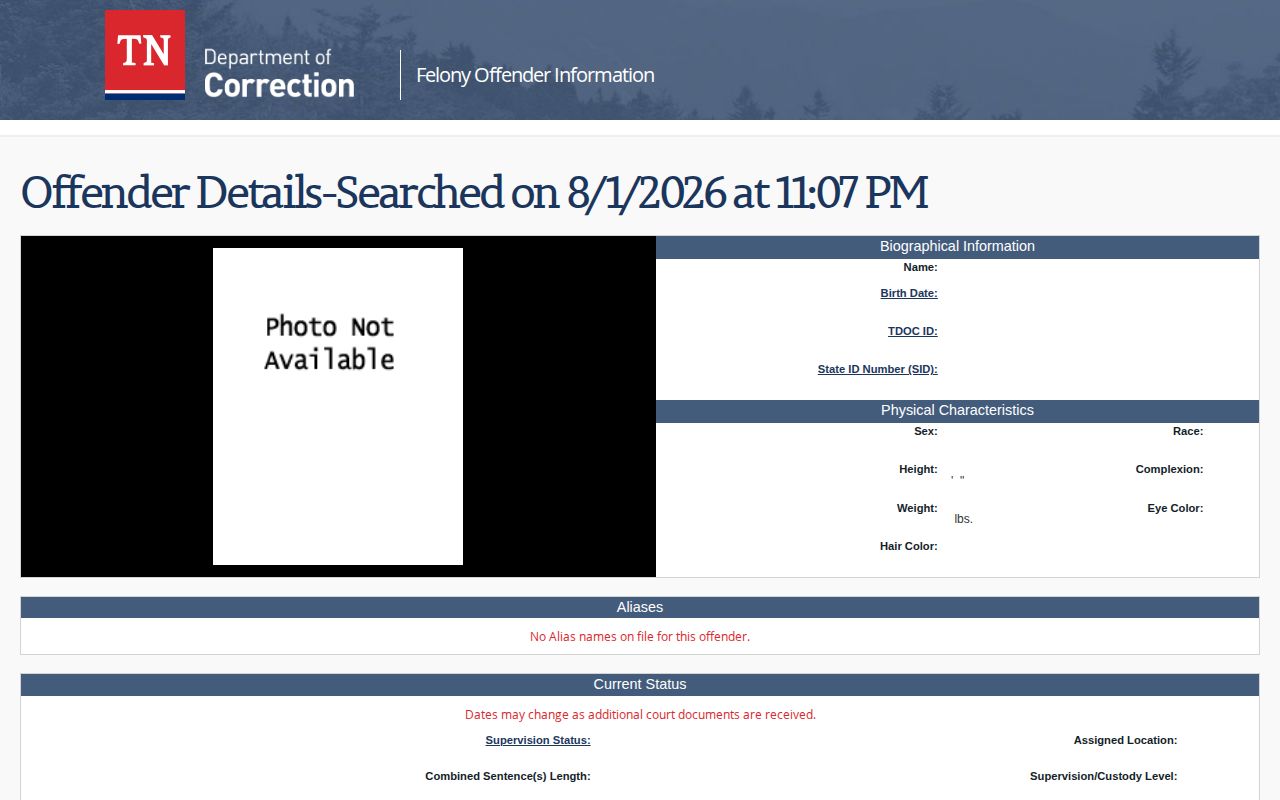
The screenshot is an interface reference. The live person's record controls, and FOIL warns that dates can change when further court documents arrive.
Tennessee Credits and Clay County Releases
Tenn. Code Ann. § 40-35-501 is central to state release eligibility. Tennessee does not have one percentage that fits every sentence. Some enumerated offenses use an 85-percent eligibility floor. The Truth in Sentencing Act of 2022 established 100-percent service rules for certain offenses committed on or after July 1, 2022, with only the credit effects allowed by the governing law. Later amendments and offense categories matter, so the law effective on the offense date must be used.
TDOC, not a public website author, performs the authoritative state calculation. Section 41-21-236 governs state prisoner sentence-reduction credits. Authorized conduct, work, or program credits may be earned, withheld, forfeited, restored, or limited by the sentence law. Credits operate inside the sentence rules. They do not erase a mandatory minimum, another sentence, a Board denial, or a detainer.
Sentence structure matters as well. Consecutive sentences can add periods of ineligibility, while concurrent terms can align differently. Pretrial jail credit must come from the judgment or a later order. For some one-to-two-year felony sentences, determinate release can place the balance on probation at the earliest lawful RED after the statutory process. That route differs from discretionary parole and from a local misdemeanor jail calculation.
Note: Never state that every Tennessee prisoner serves 85 percent; the offense, offense date, classification, and controlling statute determine the rule.
Clay County Jail Credit Calculation
Clay County jail time cannot safely be calculated with the TDOC method. Local jail or workhouse credits arise under Tenn. Code Ann. § 41-2-111 and the court's judgment. A misdemeanor term, split confinement, or local period of a felony case can have inputs that do not match a state-prison sentence.
Obtain the signed judgment and any jail-credit order from the sentencing clerk. Then ask the Clay County Sheriff's Office for the existing facility time computation or release order. The sheriff implements the judgment and lawful credits but does not rewrite the sentence. If the person is still awaiting trial, do not attempt this calculation at all.
The executed local event is best shown by the permanent jail-register entry. Tennessee's sheriff records retention schedule keeps that register permanently. Release orders and ordinary booking or movement records are generally five-year series. This difference makes the register especially useful for an older Clay County release.
No sourced Clay County policy says a Sunday or holiday date automatically creates an early Friday release. Ask the sheriff and court about the controlling order rather than applying a generic weekend rule.
A local calculation also needs the correct legal category. A bond release is not calculated from good time. A person held before trial leaves when the court and jail have completed the controlling bond or release process, unless another hold applies. Time served, sentence expiration, probation after split confinement, and transfer to TDOC each require different proof. The judgment explains the legal term, while the jail register records when Clay County custody actually ended.
If staff reports “sent to TDOC,” stop using the county calculation as the projected gate date. The movement entry should identify the destination, and the state sentence should then be checked in FOIL. This handoff matters because the person has left Clay County Jail without entering the community. The correct phrase is transfer from county custody until the state record later shows parole, probation, another community status, expiration, or discharge.
Why Clay County Release Dates Change
A valid projection can move when the facts or governing record change. Some changes affect eligibility. Others block an otherwise available release, and still others correct a prior calculation. The source of the change shows which office can verify it.
| Factor | Possible effect | Confirm with |
|---|---|---|
| Credit earned or restored | May advance a date within legal limits | TDOC or jail computation record |
| Credit forfeited | May move eligibility later | Custodial disciplinary and sentence record |
| Corrected jail credit | Changes credited time | Clay County judgment or later court order |
| Concurrent or consecutive terms | Changes how sentence periods align | Judgment and TDOC calculation |
| New sentence or appeal | Can alter the controlling term | Court docket and signed order |
| Parole denial or deferral | Release may not occur at RED | Board result and FOIL |
| Detainer or hold | Can cause transfer or continued custody | Holding and receiving agencies |
A detainer is a request or legal basis for another agency to take or hold the person. It can turn an apparent release from Clay County into a transfer. The local register or movement record should be read before calling the person free.
Confirm Clay County Actual Release
For a local event, call the sheriff first and ask whether the person is no longer in Clay County custody and whether the destination was the community or another agency. Request the jail-register entry for durable proof. Add the release order when the authority matters, and the movement entry when a transfer is possible.
For state custody, read the current FOIL status with all sentence rows, then obtain TDOC records if the public display is not enough. A parole grant also needs the later custody or supervision status. District 31 in Cookeville serves Clay County community supervision, but its office listing is not proof of the original prison exit.
Tennessee SAVIN/VINELink can send a custody-change alert from participating agencies. The VINELink inmate check explains how to select the Tennessee record and register. Alerts can lag, and a “released” alert does not reveal whether the event was a transfer. Confirm it with the agency that supplied the status.
For an older local event, request the permanent inmate-register entry by name and approximate commitment period. Ordinary release orders and movement records may no longer exist after their retention period, while the register should preserve commitment and release dates. If the legal reason matters, also request the disposed-case docket and judgment from the Clay County clerk. A court disposition date may differ from the moment jail custody ended.
For a state prisoner approaching RED, check the weekly Board hearing path if parole is possible. Current schedules are obtained from the Board and remain subject to change. After a hearing, FOIL may show Parole Hearing Result, but a favorable result still needs later confirmation because an approved release plan and other conditions may stand between the vote and departure. Once FOIL shows community supervision, District 31 is the Clay-serving field office. Full sentence discharge remains a separate status.
Federal and immigration dates should stay outside the Clay County or TDOC formulas. BOP maintains its own federal sentence locator, while ICE's locator concerns immigration detention. If the Clay movement record points to either system, follow that receiving agency. A county exit date may then mark transfer, not freedom, and no local credit estimate can establish the later release.
Note: Record the retrieval date and exact wording because a projected date, location, or supervision label may later change.