
Clay County Parole Versus Probation
Parole and probation can both place a Clay County resident in the community, but they come from different authorities. The Tennessee Board of Parole decides whether an eligible state prisoner receives parole. TDOC Community Supervision then manages field supervision. A Clay County trial court orders probation, sometimes without a prison term and sometimes after split confinement. The court judgment controls that probation term.
A person on either form of supervision has left a jail or prison setting, yet the sentence may still be active. Full expiration or discharge is a later event. Determinate release probation is another state route for some felony sentences and should not be mislabeled as a discretionary parole grant.
| Point | Parole | Probation |
|---|---|---|
| Authority | Tennessee Board of Parole | Clay County trial court |
| Starting record | Board decision and TDOC status | Signed judgment or probation order |
| Field supervision | TDOC Community Supervision | TDOC Community Supervision when state supervised |
| Ending proof | Expiration, discharge, or later Board and TDOC record | Court or TDOC discharge record, as applicable |
- Parole
- Conditional community release authorized by the Board before the state sentence fully expires.
- Probation
- A community sentence imposed by a court, with conditions that remain in force for the ordered term.
- Discharge
- The documented end of supervision or sentence authority, not merely release from a building.
- Revocation
- An official action that can cancel community supervision and return a person to custody.
Check Clay County Release Supervision
The public starting point is the Tennessee Department of Correction's Felony Offender Information Lookup, known as FOIL. Search by TDOC identification number when possible. A name search can use last name, first name, race, sex, and age to narrow matches. Open the record and confirm the TDOC number before relying on its supervision status or assigned location.
FOIL is a felony-corrections lookup, not a full Clay County jail history and not a warrant database. Someone released on a local bond may never appear there. If Clay County Jail reports a transfer to TDOC, however, FOIL becomes the proper statewide track. Follow this order:
- Confirm the person left Clay County custody and ask whether the event was a community release or a transfer.
- Search FOIL using the TDOC ID or enough name and identity details to avoid a same-name error.
- Read Supervision Status and Assigned Location exactly as displayed. Do not turn “inactive” into a more specific conclusion.
- Use the TDOC field-office directory to confirm which office serves the record.
- For parole, pair FOIL with the Board decision. For probation, request the signed Clay County judgment or probation order.
- When the end date matters, obtain the official discharge, expiration, revocation, or court record instead of relying on an old screen.
For the larger released-person workflow, the Clay County released inmate search explains how the jail register, court file, VINE, and FOIL answer different parts of the same question.
Clay County District 31 Office
Clay County is assigned to TDOC Community Supervision District 31 rather than to a separately listed Clay office. The current TDOC field-office directory places the county with the Cookeville office. That office can address public operational questions about field supervision, but it does not replace a court judgment or a Tennessee Board of Parole decision.
TDOC Community Supervision, District 31851 South Willow Avenue, Suite 202
Cookeville, TN
(931) 526-7165
The directory image below is tied to the official TDOC source. It provides a useful check against older references that assign Clay County to another district.
View the official District 31 listing for Clay County.
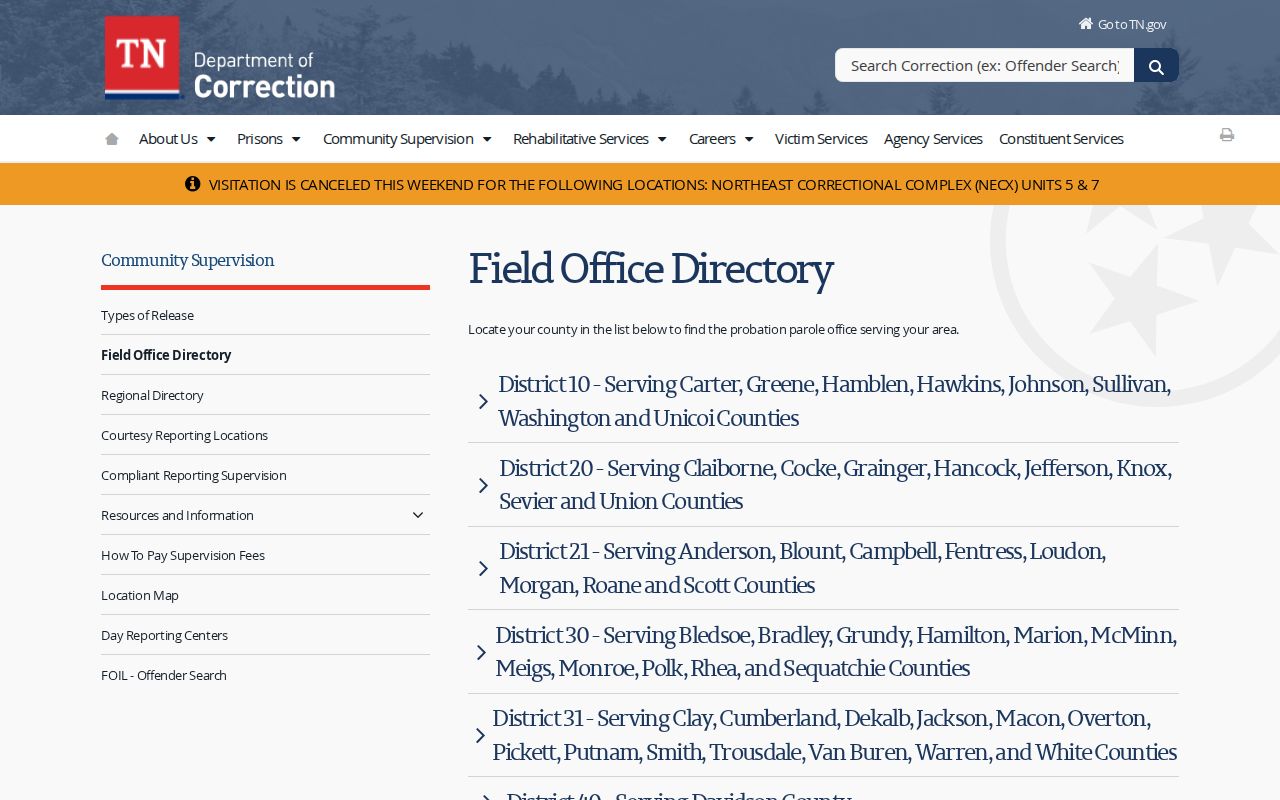
The county name and Cookeville office should be checked together before calling, since district assignments can change.
Note: Ask only for information the agency is legally permitted to confirm, and use an official order for the legal basis of supervision.
Clay County Parole Hearing Records
A hearing date does not mean release is certain. The Board may grant, deny, defer, continue, rescind, or later revoke a parole matter. Hearing officers make recommendations, while the required Board concurrence produces the decision. Even a grant may depend on an approved release plan and other pre-release conditions before the person physically leaves custody.
The Board's current hearing page says state-prison and county-jail schedules are updated weekly on Monday, or Tuesday after a Monday holiday. Current schedules are requested at BD.HearingSchedules@tn.gov. Older calendar links in search results are not reliable. FOIL can display Parole Hearing Date and Parole Hearing Result fields, while Board contact or a public-record request is the stronger path to a final notice.
An appeal is also a distinct stage. The Board's parole appeal procedure identifies significant new information, official misconduct, and significant procedural error as grounds. It gives a filing limit of 45 days after the offender receives the final-decision notice. An appeal does not itself prove release or restore supervision.
The official hearing types also show why a single calendar entry is not enough. Grant hearings consider release, while preliminary and final revocation hearings address alleged violations after release. Custodial hearings, pre-parole and post-parole rescission hearings, time-setting hearings, and appeal hearings serve other roles. A rescission matter can change the effect of an earlier grant before release is carried out. At a final revocation hearing, the Board may revoke or reinstate supervision. Record the hearing type, result, and retrieval date rather than reducing every entry to “approved” or “denied.”
Clay County Absconder Status Limits
No official public statewide list of ordinary TDOC parole or probation absconders was found in the research. FOIL should not be described as a warrant search. “Absconder” generally means the supervising agency has formally classified a person as having stopped reporting or otherwise become unavailable for supervision. A warrant is a separate legal event.
Do not infer either status from an old address, a missed appointment, a silent phone line, or the fact that a person cannot be found in a web search. Start with FOIL's public Supervision Status and Assigned Location. Then contact District 31, the Clay County court, or law enforcement for information that office can lawfully confirm. A violation report may lead to a preliminary or final revocation hearing, where supervision can be revoked or reinstated.
Tennessee SAVIN and VINELink can provide custody-change notifications from participating agencies. They do not publish a complete probation violation or warrant history. An alert should be confirmed with the reporting agency when the destination or current authority matters.
Note: An automated status can lag, so an urgent safety concern belongs with the appropriate agency or 911, not a repeated web refresh.
Clay County Release Property Records
Supervision questions often arise alongside practical release issues. Tennessee's sheriff records schedule gives a precise local paper trail for property. A receipt signed by the released person and witnessed by the releasing officer inventories property, valuables, and cash returned at release. The schedule treats that receipt as permanent, so it can answer a narrow property-return question after shorter-lived booking material is gone.
The receipt does not prove parole, probation, or sentence discharge. It documents the physical closeout of possessions at the county facility. Request it from the Clay County Sheriff's Office by identifying the person and approximate booking period. For a lost or expired identification card after release, the Tennessee Department of Safety identification-license process is separate from any effort to correct a jail or court record.
Clay County Supervision Discharge
Release from confinement, completion of parole or probation, and full sentence discharge are three different events. A person may live in Clay County while the sentence remains active. Parole ends through the applicable TDOC and Board process. Probation ends under the court order and any state supervision record. Expiration or discharge should be read from the official record without adding a label that the record does not use.
If FOIL shows inactive, compare the sentence fields and obtain a fuller TDOC record when needed. A Clay County court file may contain a probation discharge, revocation, amended judgment, or satisfaction order. The Circuit Court Clerk serves the local trial-level criminal record path. Tennessee's Public Case History portal covers appellate matters and is not a full Clay County criminal docket.
A precise request names the person, case or TDOC number, the kind of order sought, and a narrow date range. That approach lets the custodian locate an existing record without being asked to create a new conclusion. It also keeps the difference between physical release and legal discharge clear.
For Clay County trial records, ask for the docket and the signed order that resolves the point at issue. The useful record may be a probation order, amended judgment, revocation order, or discharge entry. A docket event alone may only show that something was filed or heard. For TDOC supervision, use the official records channel when FOIL lacks enough detail. State the TDOC ID, requested record type, and relevant period. The agency that created the record is the best source for its meaning.
Release notifications do not replace these final records. VINE can report a custody change, and FOIL can show a current public status, but neither should be rewritten as a court's legal conclusion. If one source conflicts with another, check the last custodial agency, the Clay County judgment, and the later TDOC or Board action in date order.